 گردآوری و ترجمه از خسرو شهمردان: پارسیانهند
در کار بازگانی مردمانی بیباک و سرشار از استعداد هستند. ایشان در گذشته
سواحل دور از هند را در جستجوی راههای جدید بازرگانی کاویدهاند. آنها
در بسیاری از این سرزمینهای دور تجارتخانه و مراکز بازرگانی گوناگونی
برپا داشتهاند. یکی از این کانونهای بازرگانی که در یک دورهی زمانی
پایگاهی برای داد و ستد بازرگانان پارسی شده بود، بندر «عدن» در کشور یمن
واقع در نوار جنوبی شبهه جزیره عربستان است. زمانی «عدن» بهمانند بندر
«سنگاپور» به خواست انگلیسیها بندر آزاد بازرگانی شده بود. «عدن» مانند
یک پل بازرگانی دریای سرخ و کانال سوئز را به آبهای گرم خاور پیوند
میداد. این جایگاه عدن، چشمانداز بازرگانی خوبی را پیش روی بازرگانان
پارسی قرار داده و شوند آن شده بود تا بسیاری از ایشان راه بندر عدن را در
پیش گیرند.
گردآوری و ترجمه از خسرو شهمردان: پارسیانهند
در کار بازگانی مردمانی بیباک و سرشار از استعداد هستند. ایشان در گذشته
سواحل دور از هند را در جستجوی راههای جدید بازرگانی کاویدهاند. آنها
در بسیاری از این سرزمینهای دور تجارتخانه و مراکز بازرگانی گوناگونی
برپا داشتهاند. یکی از این کانونهای بازرگانی که در یک دورهی زمانی
پایگاهی برای داد و ستد بازرگانان پارسی شده بود، بندر «عدن» در کشور یمن
واقع در نوار جنوبی شبهه جزیره عربستان است. زمانی «عدن» بهمانند بندر
«سنگاپور» به خواست انگلیسیها بندر آزاد بازرگانی شده بود. «عدن» مانند
یک پل بازرگانی دریای سرخ و کانال سوئز را به آبهای گرم خاور پیوند
میداد. این جایگاه عدن، چشمانداز بازرگانی خوبی را پیش روی بازرگانان
پارسی قرار داده و شوند آن شده بود تا بسیاری از ایشان راه بندر عدن را در
پیش گیرند.


Era of No Temples
From the accounts of Herodotus (c.
430 BCE), and from the earliest archaeological sites discovered so far,
that up to the 5th century BCE, Zorastrians "had no temples nor altars,
and consider(ed) the use of them a sign of folly."
Further, Zorastrian scriptures do not prescribe worshipping in a temple and make no mention of Zorastrian places of worship. Traditionally, Zorastrians worship individually at home, or in the open, facing a source of light. When they wished to worship as a community, they did so in open air gathering areas around a podium where a fire was lit. The gathering areas were on hillsides and hilltops.
Further, Zorastrian scriptures do not prescribe worshipping in a temple and make no mention of Zorastrian places of worship. Traditionally, Zorastrians worship individually at home, or in the open, facing a source of light. When they wished to worship as a community, they did so in open air gathering areas around a podium where a fire was lit. The gathering areas were on hillsides and hilltops.
Advent of Fire Houses and Temples
About
400 to 500 years after Herodotus' observations, by the turn of the
millennium, Strabo in the first century ACE, noted that the magi of Cappadocia (now in Turkey), "... have Pyraetheia (fire-houses),
noteworthy enclosures; and in the midst of these there is an 'altar' on
which there is a large quantity of ashes where the magi keep the fire
ever burning." The altar that Strabo refers to is not an altar in the
usual sense. He describes it as a fire holder.
While the magi during Strabo's time (around the start of the first millennium) had started to use the fire-houses for their worship rituals, there is no indication that the community at that time time joined the Magi in rituals at the fire-houses (atash-gah) or that the magi worshiped fire as many have suggested. The community continued to conduct their worship events in the open. Nevertheless, the fire-houses did eventually become fire temples used by the community. In subsequent years, enclosed fire temples became standard. Today, there are no designated or formal open places of worship, and the temples that do exist are multi-purpose facilities to accommodate community gatherings (saal, jashans, etc...).
While the magi during Strabo's time (around the start of the first millennium) had started to use the fire-houses for their worship rituals, there is no indication that the community at that time time joined the Magi in rituals at the fire-houses (atash-gah) or that the magi worshiped fire as many have suggested. The community continued to conduct their worship events in the open. Nevertheless, the fire-houses did eventually become fire temples used by the community. In subsequent years, enclosed fire temples became standard. Today, there are no designated or formal open places of worship, and the temples that do exist are multi-purpose facilities to accommodate community gatherings (saal, jashans, etc...).
Development of the Fire House Concept
In
ancient times, frequently lighting a new fire would have been
difficult. In addition, maintaining a continuous fire in homes would
have denuded a fragile environment of trees. Zoroastrian communities
therefore developed community fire houses that housed an ever burning
flame tended at all hours by fire keepers. Every evening, the fire
keeper would carefully cover the fire with its ashes so that it would
continue smouldering throughout the night while saving fuel, ready to
resume when the ashes were removed in the morning. When needed,
householders would come and light their house fires from the central
community fire. The fire-houses were central to, and a vital part of
each community. Fire-keeping was a profession supported by the
community.
The fire houses later came to be known in Persian as atash gahs and the fire keepers were called atharvans, a task that became part of the magi's profession.
The fire houses later came to be known in Persian as atash gahs and the fire keepers were called atharvans, a task that became part of the magi's profession.
The
old stories told by elders from generation to generation suggests the
importance of fire and how difficult it was for those in need of it to
get fire going at their homes. Only the privileged had fire, and that
the needy would sometimes walk over to someone else's home to beg for a
bit of fire to take back. (Pire-Kharkan - Golkhandan Ardeshiri)
Chahar-Taqi Fire Temple Design
Together
with the Parthian era fire-temple / fire-house (atash-gah) shown below,
the Ani fire-house is an early example of the fire temple design that
came to be known in Iran as chahar-taqi meaning four directions.
The walls and openings faced the four cardinal directions. The alignment
of the walls or pillars of the fire-houses with the solar-based
cardinal points has led some to believe that the fire-houses/temples
served an additional function - that of using the position of the sun at
sunrise, noon-meridian and sunset to determine seasons and significant
days of the year. Zorastrians mark these days with festivals, jashnes or
jashans, and they were particular important for farmers in determining
sowing times and for live-stock owners as well. The chahar-taqi design
continued to be used for fire temples during the Sassanian era, that is up to 650 ACE.
Ani, Armenia, Turkey
 |
| Fire House, Ani, Turkish Armenia, 1st - 4th century ACE. Image Credit: Virtual Ani |
 |
| Map of Turkey showing the location of Ani |
 |
| Reconstruction image of the Ani Fire House Image Credit: Virtual Ani |
Ruins of a fire house (atash-gah) or fire temple (above and right) have been discovered in Ani, Turkish Armenia,
the area referred to by Strabo, and dating to the era in which he
lived. The region of which Ani is in close proximity to the environs
around Lake Urmia and Lake Van in an area that would have been part of the northern reaches of the Media.
The structure has massive pillars and no walls. At a later period the structure was converted into a Christian chapel by the insertion of curved walls between its four columns.
The structure which is the oldest building in the Ani site, fits Strabo's description of a Pyraetheia, a fire-house.
The shape of the roof in the reconstruction image of the Ani fire house above is speculative since among the ruins, there is no evidence of the roof. It could even have been a dome (see standing chahar-taqi designs from the same era below). The massiveness of the columns suggests a stone roof, and stones similar to the rest of the structure (not not used elsewhere in Ani) have been found in part of the citadel wall built during the seventh century ACE. Archaeologists surmise that the citadel stones were taken from the fire house.
The structure has massive pillars and no walls. At a later period the structure was converted into a Christian chapel by the insertion of curved walls between its four columns.
The structure which is the oldest building in the Ani site, fits Strabo's description of a Pyraetheia, a fire-house.
The shape of the roof in the reconstruction image of the Ani fire house above is speculative since among the ruins, there is no evidence of the roof. It could even have been a dome (see standing chahar-taqi designs from the same era below). The massiveness of the columns suggests a stone roof, and stones similar to the rest of the structure (not not used elsewhere in Ani) have been found in part of the citadel wall built during the seventh century ACE. Archaeologists surmise that the citadel stones were taken from the fire house.
Chahar-Taqi Fire Temples in Iran
The
chahar-taqi plan of the Ani fire house is similar to other early
Parthian (247 BCE-224 CE) Sassanian (226-651 ACE) fire temples found in
Iranian. These structures are simple, open, yet substantial (noteworthy
in Strabo's words). They are usually situated within a walled area.
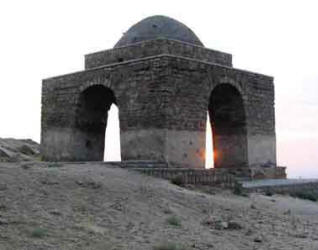
The earliest example of a chahar-taqi temple in present-day Iran that we have been able to locate is a photograph (see below) taken by Ali Majdar at Flickr. Ali Majdar states that the temple dates to the Parthian era 247 BCE-224 CE, and further that its name, Bazeh Khur indicates that the temple also served as a solar observatory in order to fix dates. Bazeh means mountain edge and Khur means Sun. This temple is in reasoanble condition and is located in the eastern province of Khorasan while many of the other examples we have found are in western Iran.
Note the use of domes. While some may think that the use of domes is an Arab-Islamic design, the use of domes in Iranian-Zoroastrian structures predates the former.
The earliest example of a chahar-taqi temple in present-day Iran that we have been able to locate is a photograph (see below) taken by Ali Majdar at Flickr. Ali Majdar states that the temple dates to the Parthian era 247 BCE-224 CE, and further that its name, Bazeh Khur indicates that the temple also served as a solar observatory in order to fix dates. Bazeh means mountain edge and Khur means Sun. This temple is in reasoanble condition and is located in the eastern province of Khorasan while many of the other examples we have found are in western Iran.
Note the use of domes. While some may think that the use of domes is an Arab-Islamic design, the use of domes in Iranian-Zoroastrian structures predates the former.
 |
| Bazeh Khur Fire Temple, Khorasan One of the oldest Chahar-Taqi temples dating to the Parthian era 247 BCE-224 CE. 80 km s of Mashhad & at Robat Sefid Village's edge. Image credit: Ali Majdar at Flickr |
 |
| Another image of the Bazeh Khur fire temple. Image credit: www.itto.org |
|


|

|


Surakhani, Azerbaijan Chahar Taqi Temple
About
550 km (330 miles) directly west of Ani, on the coast of the Caspian
Sea in Azerbaijan's Abseron peninsula, there is an enigmatic seventeenth
century CE atash-gah, in the village of Surakhani located fifteen km.
west of the capital Baku. UNESCO has designated the complex as a world
heritage site. The temple ceased to be used in 1883 CE.
This atash-gah follows the chahar-taqi plan.
The are reports of ruins of a 9th century CE fire temple in the Caucasus mountains at Khynalyg (also spelt Khinalyg, Khinalugh, Xinaliq) village near Quba (Guba, Kuba), some 165 km northwest of Baku, as well as one in the neighbouring country of Georgia's capital, Tblisi (see Sasanika site).
[Surakhani is also spelt Surakhany or Suraxani]
This atash-gah follows the chahar-taqi plan.
The are reports of ruins of a 9th century CE fire temple in the Caucasus mountains at Khynalyg (also spelt Khinalyg, Khinalugh, Xinaliq) village near Quba (Guba, Kuba), some 165 km northwest of Baku, as well as one in the neighbouring country of Georgia's capital, Tblisi (see Sasanika site).
[Surakhani is also spelt Surakhany or Suraxani]
 |
| Map of Caucasus region (Azerbaijan, Armenia and E. Turkey) showing the location of Ani, Quba and Surakhani |
 |
| Atash-gah in Surakhani, Baku, Azerbaijan The surrounding walls form a pentagon. |
 |
| Atash-gah in Surakhani, Baku, Azerbaijan Natural gas fires can be seen burning in the top corners. The gas rises through ducts constructed in the four corners of the structure. Image Credit: Various. Advantour & Ecotourism |
The name Azerbaijan derives
from the Middle and Old Persian Adar-badhagan and Atur-patakan (from
the Avestan atere-pata cf. Farvardin Yasht), meaning protected by fire.
Surakhani derives from the Persian words Surakh meaning hole or Surkh /
Sorkh meaning red, and khani meaning room, source or fountain. The
region is known for its continuously burning natural gas fires which to
the ancients must have seemed like the miraculous phenomenon of an ever-burning fire -
a symbol of special importance in Zoroastrianism. In ancient texts,
Azerbaijan was known as the land of fire and burning hillsides.
Reference to "the eternal fires of Baku" appears in 5 ACE in a volume entitled Stories by the Byzantine author Prisk of Pania. He quotes Romul, the Ambassador to Rome, who mentioned that when the Hun leaders came to Rome to sign a peace treaty, they had traveled via the Caucasus along the Caspian Sea where they had seen "a flame that appears from a rock underwater".
Reference to "the eternal fires of Baku" appears in 5 ACE in a volume entitled Stories by the Byzantine author Prisk of Pania. He quotes Romul, the Ambassador to Rome, who mentioned that when the Hun leaders came to Rome to sign a peace treaty, they had traveled via the Caucasus along the Caspian Sea where they had seen "a flame that appears from a rock underwater".
Surakhani - Hindu or Zoroastrian Temple?
 |
| Atash-gah Surakhani, Baku, Azerbaijan plaque in Devnagri script Image Credit: Rita Willaert at Flickr |
There
are twenty inscriptions embedded in the the stone walls of the complex.
Eighteen are in the Nagari Devnagri script, one is in Punjabi using the
Gurumukhi script and one is a bilingual inscription in Sanskrit and
Persian. the bilingual inscription is dedicated to Lord Ganesh, Jwalaji
and fire, and is dated Samvat 1802 (1745-46 CE). The Punjabi language
inscription is a quotation from the Adi Granth.
The other inscriptions include an invocation to Lord Shiva. Taken as a set, the dates on the inscriptions range from Samvat 1725 to Samvat 1873, corresponding to the period from 1668 CE to 1816 CE. The present structure is relatively modern and the 17th century is a possible date for its construction. One report states that local records exist that the structure was built by the Baku Hindu trading community around the time of the annexation of Baku by the Russian Empire following the Russo-Persian War (1722-1723 CE).
Jonas Hanway commenting in his, An Historical Account of the British Trade Over the Caspian Sea, 1753 CE states "The Persians have very little maritime strength... their ship carpenters on the Caspian were mostly Indians... there is a little temple, in which the Indians now worship: near the altar about 3 feet high is a large hollow cane, from the end of which iffues a blue flame... . These Indians affirm, that this flame has continued ever since the flood, and they believe it will last to the end of the world. ...Here are generally forty or fifty of these poor devotees, who come on a pilgrimage from their own country."
The Baku Hindu trading community is thought to have originated primarily from Multan located in the Punjab region of the Indus valley (in today's Pakistan) and who plied their trade along the Grand Trunk Road, part of the old Aryan trade roads.
The single inscription mentioning Jwalaji venerates natural fires such as volcanoes and natural gas fires. In the present Indian state of Himachal Pradesh, there is a Jwalaji temple similarly constructed over a natural gas fire. The place is called Jwalamukhi, Jwala meaning a natural fire and Mukhi meaning mouth. There the fire is considered an incarnation of the goddess Durga.
The complex as it stands was clearly used as a Hindu temple. However, The complex is quite unlike other Hindu temples. Instead, the pentagonal perimeter structure consists of cubicles much like a caravan-serai and in the centre of the enclosed courtyard is a chahar-taqi building whose design is entirely consistent with the chahar-taqi Zoroastrian atash-gahs of Ani as well as those of ancient and medieval Persia. There is a strong possibility that prior to its use as a Hindu temple, a predecessor structure existed that was a Zoroastrian fire temple. With the decline of the Zoroastrian community and an abandoned structure would have been a candidate for occupation and use by the growing Hindu trading community. The present structure could have been modelled on a previous Zoroastrian structure. Alternatively, the present structure could have been built over the ruins of a Zoroastrian atash-gah or it could be a renovation of a previous Zoroastrian atash-gah. Even today, local tradition holds that the structure was a Zoroastrian atash-gah.
Professor A. V. Williams Jackson (1911 CE) while commenting on the observations of Jonas Hanway (1753 CE), left open the possibility that Zoroastrians may have worshipped alongside the larger Hindu community at the shrine. The Sikh community must also have worshipped alongside the Hindu community.
In the 1800s, the population of Hindus and Sikhs in Azerbaijan declined. Sir Jivanji Jamshedji Modi (1854-1933) in his book My Travels Outside Bombay Iran, Azerbaijan, Baku (1926) (translated from Gujerati by Soli Dastur) notes: "the original trade routes and customs changed and the visits of the Hindu traders diminished. And from the original group of the Brahmins, some passed away and a few that were left went back to their original home land." By the time of Modi's visit in 1925, the Surakhani atash gah had been abandoned.
According to authors from the 1800s, between the time when the atash gah was abandoned by the Hindus in the and Modi's visit in 1925, that is, in the 1800s, the Surakhani atash gah was briefly under the care of Zoroastrians.
James Bryce, in Transcaucasia and Ararat: Being Notes of a Vacation Tour in the Autumn Of 1876, noted, "...after they (the Zoroastrians) were extirpated from Persia by the Mohammedans, who hate them bitterly, some few occasionally slunk here (Azerbaijan) on pilgrimage" and that "under the more tolerant sway of the Czar (Azerbaijan was then part of the Russian empire), a solitary priest of fire is maintained by the Parsee community of Bombay, who inhabits a small temple built over one of the springs." (We do know that in the 1800s, the Parsees of Bombay lent their assistance to the Zoroastrians of Iran and sought to ameliorate the suffering of their co-religionists in their ancestral lands.)
A few years earlier, in 1858, French novelist Alexander Dumas (1802 - 1870 CE) had visited the atash gah and noted: "...the whole world is aware of the Atash gah in Baku. My compatriots who want to see the fire-worshippers must be quick because already there are so few left in the temple, just one old man and two younger ones about 30-35 years old."
In 1905, J. Henry in his book, Baku , states: "When 25 years ago (1880), the priestly attendant - a Parsee from India and the last of the long list of Fire-worshippers reaching 2500 years died at Surakhani."
From these accounts, we gather that the Surakhani atash gah was indeed a Zoroastrian place of worship, and that for a hundred and seventy years - from approximately 1660 CE to 1830 CE - it served as a Hindu temple as well.
The other inscriptions include an invocation to Lord Shiva. Taken as a set, the dates on the inscriptions range from Samvat 1725 to Samvat 1873, corresponding to the period from 1668 CE to 1816 CE. The present structure is relatively modern and the 17th century is a possible date for its construction. One report states that local records exist that the structure was built by the Baku Hindu trading community around the time of the annexation of Baku by the Russian Empire following the Russo-Persian War (1722-1723 CE).
Jonas Hanway commenting in his, An Historical Account of the British Trade Over the Caspian Sea, 1753 CE states "The Persians have very little maritime strength... their ship carpenters on the Caspian were mostly Indians... there is a little temple, in which the Indians now worship: near the altar about 3 feet high is a large hollow cane, from the end of which iffues a blue flame... . These Indians affirm, that this flame has continued ever since the flood, and they believe it will last to the end of the world. ...Here are generally forty or fifty of these poor devotees, who come on a pilgrimage from their own country."
The Baku Hindu trading community is thought to have originated primarily from Multan located in the Punjab region of the Indus valley (in today's Pakistan) and who plied their trade along the Grand Trunk Road, part of the old Aryan trade roads.
The single inscription mentioning Jwalaji venerates natural fires such as volcanoes and natural gas fires. In the present Indian state of Himachal Pradesh, there is a Jwalaji temple similarly constructed over a natural gas fire. The place is called Jwalamukhi, Jwala meaning a natural fire and Mukhi meaning mouth. There the fire is considered an incarnation of the goddess Durga.
The complex as it stands was clearly used as a Hindu temple. However, The complex is quite unlike other Hindu temples. Instead, the pentagonal perimeter structure consists of cubicles much like a caravan-serai and in the centre of the enclosed courtyard is a chahar-taqi building whose design is entirely consistent with the chahar-taqi Zoroastrian atash-gahs of Ani as well as those of ancient and medieval Persia. There is a strong possibility that prior to its use as a Hindu temple, a predecessor structure existed that was a Zoroastrian fire temple. With the decline of the Zoroastrian community and an abandoned structure would have been a candidate for occupation and use by the growing Hindu trading community. The present structure could have been modelled on a previous Zoroastrian structure. Alternatively, the present structure could have been built over the ruins of a Zoroastrian atash-gah or it could be a renovation of a previous Zoroastrian atash-gah. Even today, local tradition holds that the structure was a Zoroastrian atash-gah.
Professor A. V. Williams Jackson (1911 CE) while commenting on the observations of Jonas Hanway (1753 CE), left open the possibility that Zoroastrians may have worshipped alongside the larger Hindu community at the shrine. The Sikh community must also have worshipped alongside the Hindu community.
In the 1800s, the population of Hindus and Sikhs in Azerbaijan declined. Sir Jivanji Jamshedji Modi (1854-1933) in his book My Travels Outside Bombay Iran, Azerbaijan, Baku (1926) (translated from Gujerati by Soli Dastur) notes: "the original trade routes and customs changed and the visits of the Hindu traders diminished. And from the original group of the Brahmins, some passed away and a few that were left went back to their original home land." By the time of Modi's visit in 1925, the Surakhani atash gah had been abandoned.
According to authors from the 1800s, between the time when the atash gah was abandoned by the Hindus in the and Modi's visit in 1925, that is, in the 1800s, the Surakhani atash gah was briefly under the care of Zoroastrians.
James Bryce, in Transcaucasia and Ararat: Being Notes of a Vacation Tour in the Autumn Of 1876, noted, "...after they (the Zoroastrians) were extirpated from Persia by the Mohammedans, who hate them bitterly, some few occasionally slunk here (Azerbaijan) on pilgrimage" and that "under the more tolerant sway of the Czar (Azerbaijan was then part of the Russian empire), a solitary priest of fire is maintained by the Parsee community of Bombay, who inhabits a small temple built over one of the springs." (We do know that in the 1800s, the Parsees of Bombay lent their assistance to the Zoroastrians of Iran and sought to ameliorate the suffering of their co-religionists in their ancestral lands.)
A few years earlier, in 1858, French novelist Alexander Dumas (1802 - 1870 CE) had visited the atash gah and noted: "...the whole world is aware of the Atash gah in Baku. My compatriots who want to see the fire-worshippers must be quick because already there are so few left in the temple, just one old man and two younger ones about 30-35 years old."
In 1905, J. Henry in his book, Baku , states: "When 25 years ago (1880), the priestly attendant - a Parsee from India and the last of the long list of Fire-worshippers reaching 2500 years died at Surakhani."
From these accounts, we gather that the Surakhani atash gah was indeed a Zoroastrian place of worship, and that for a hundred and seventy years - from approximately 1660 CE to 1830 CE - it served as a Hindu temple as well.
Seven Fires
 |
| Central fire at the atash-gah in Surakhani, Baku, Azerbaijan |
For
a Zoroastrian, the presence of seven fires is auspicious and the
presence of seven natural ever-burning fires would have been
particularly auspicious. In the past, seven natural fires burned near
the present temple site. The original presence of seven fires at the
Surakhani atash-gah / fire temple site adds to the likelihood of there
having been a Zoroastrian worship site or fire temple (in the environs)
used by the local population prior to the use of the present structure
by Indian traders.
According to historical sources quoted by Alakbarov, Farid (2003), before the construction of the Indian Temple in Surakhani at the end of the 17th century ACE, the local people also worshipped at this site because of the "seven holes with burning flame".
Engelbert Kaempher, a British traveler, who visited the Surakhani atash-gah in 1683 writes: "Previously, at about 500 paces distance from the temple, there could be seen seven holes situated in a single line. In early times, flames used to erupt from these holes. Then, the fire disappeared and burst forth at another locale where later the Atash-gah was built".
From these accounts, it appears that an original worship site where "local people worshipped" (and not Hindu traders) existed some 500 paces (say 400 metres) from the present site and that the fires disappeared causing that site to be abandoned. A fire then appeared at the present site where an atash gah was built. If the practice of Zoroastrianism in the region declined after the Arab invasion, the original site as a Zoroastrian place of worship would have ceased. Then in the 17th century ACE traders from India adapted or constructed the present structure.
According to historical sources quoted by Alakbarov, Farid (2003), before the construction of the Indian Temple in Surakhani at the end of the 17th century ACE, the local people also worshipped at this site because of the "seven holes with burning flame".
Engelbert Kaempher, a British traveler, who visited the Surakhani atash-gah in 1683 writes: "Previously, at about 500 paces distance from the temple, there could be seen seven holes situated in a single line. In early times, flames used to erupt from these holes. Then, the fire disappeared and burst forth at another locale where later the Atash-gah was built".
From these accounts, it appears that an original worship site where "local people worshipped" (and not Hindu traders) existed some 500 paces (say 400 metres) from the present site and that the fires disappeared causing that site to be abandoned. A fire then appeared at the present site where an atash gah was built. If the practice of Zoroastrianism in the region declined after the Arab invasion, the original site as a Zoroastrian place of worship would have ceased. Then in the 17th century ACE traders from India adapted or constructed the present structure.


